USC Racing — Suspension & Data Acquisition
Two years with USC Racing, split between hands-on suspension work and building tools that made the car’s data useful at the track.
Ardalan Aryashad — USC Racing (Formula SAE) · Suspension & Data Acquisition
I joined USC Racing in Fall 2024, and the last two years on this team were the best and most rewarding years I’ve had. This page is the story of the parts I machined, the optimization study I ran, the design decision I defended in front of judges, and the data infrastructure I built so that 60 people could actually use the data the car was generating.
The best year in team history
Let me put the results first.
At the most recent competition, USC Racing won the autocross event outright — first place — and finished 7th overall out of roughly 120 teams. We reached the Design Finals for the third time in team history and the second year in a row: the top 10 teams, pulled aside so every judge can come at you personally with deep, specific questions about why you made each design choice. It was, by every measure, the best competition the team has ever had.
The year before, we’d already broken new ground: our first-ever podium, finishing 3rd in autocross, and our second-ever trip to the Design Finals, where we placed 6th. Getting onto that podium the first time is what convinced everyone the program had turned a corner.
The piece I’m proudest of is quieter. The data acquisition system we built drew a comment from the judges that we hadn’t dared hope for — that it was on the level of an F1 team, and that they didn’t expect to see anything close to it at a student competition. For a system I started as a single Raspberry Pi in a backpack, that meant a lot.
Cutting metal: suspension and manufacturing
My first year was almost entirely hands-on. I learned to manufacture by manufacturing.
I machined the suspension bushings on the lathe, cut parts on the water jet, and assembled full suspension corners — the uprights, control arms, and all the hardware that ties a wheel to the chassis — as well as working on the chassis itself. Over the year I was on track for all of the team’s test days, from shaking down the previous car (SCR24) and running it at the SoCal Shootout, through to building and testing the new car (SCR25).
There’s a particular kind of learning that only happens when the part you manufactured is the part bolted to a car doing 60 mph on a track. Test days are where the design assumptions meet reality, and being there for all of them is what later told me exactly what the team was missing — but more on that below.
How light is light enough? — unsprung mass optimization
The first engineering question I got to chase was deceptively simple: how light should the wheel package actually be?
Unsprung mass — the wheel, upright, and everything that moves with them over a bump — is something everyone “knows” you want to minimize. But minimizing it costs money, stiffness, and time, so I wanted a real answer for our car, not a rule of thumb. I built a quarter-car model and ran a genetic-algorithm optimization to find the mass distribution that maximized tire grip over a bump input.
The quarter-car model: a body mass on the suspension spring/damper (k₁, c₁), a wheel mass on the tire spring (k₂), excited by a road bump. Grip is the force the tire pushes into the road — and the goal is to keep that force as steady as possible over a bump.
The model came straight from our own car’s numbers (taken from the SCR24 design data): a total mass of 207.3 kg, unsprung masses of 24.64 kg front / 26.98 kg rear, a 48/52 front-rear weight split, suspension rates of 43.2 kN/m front and 27.8 kN/m rear, and a tire stiffness of 94.2 kN/m, with the damper sized for a damping ratio of 0.7. I derived the transfer function from sprung/unsprung dynamics, then turned it loose on a genetic algorithm.
The objective function is where the real problem is defined. “Maximize grip” isn’t a single number, so I built a weighted, normalized score combining three things measured against the baseline car: settling time, peak tire force, and RMS tire force — for both front and rear. The ideal is a tire that recovers a constant contact force as fast as possible after a bump, with the least sustained oscillation. I constrained the search to keep it physically sane: unsprung-mass changes capped at ±5%, total mass within ±20 kg, and spring rates kept above a sensible floor.
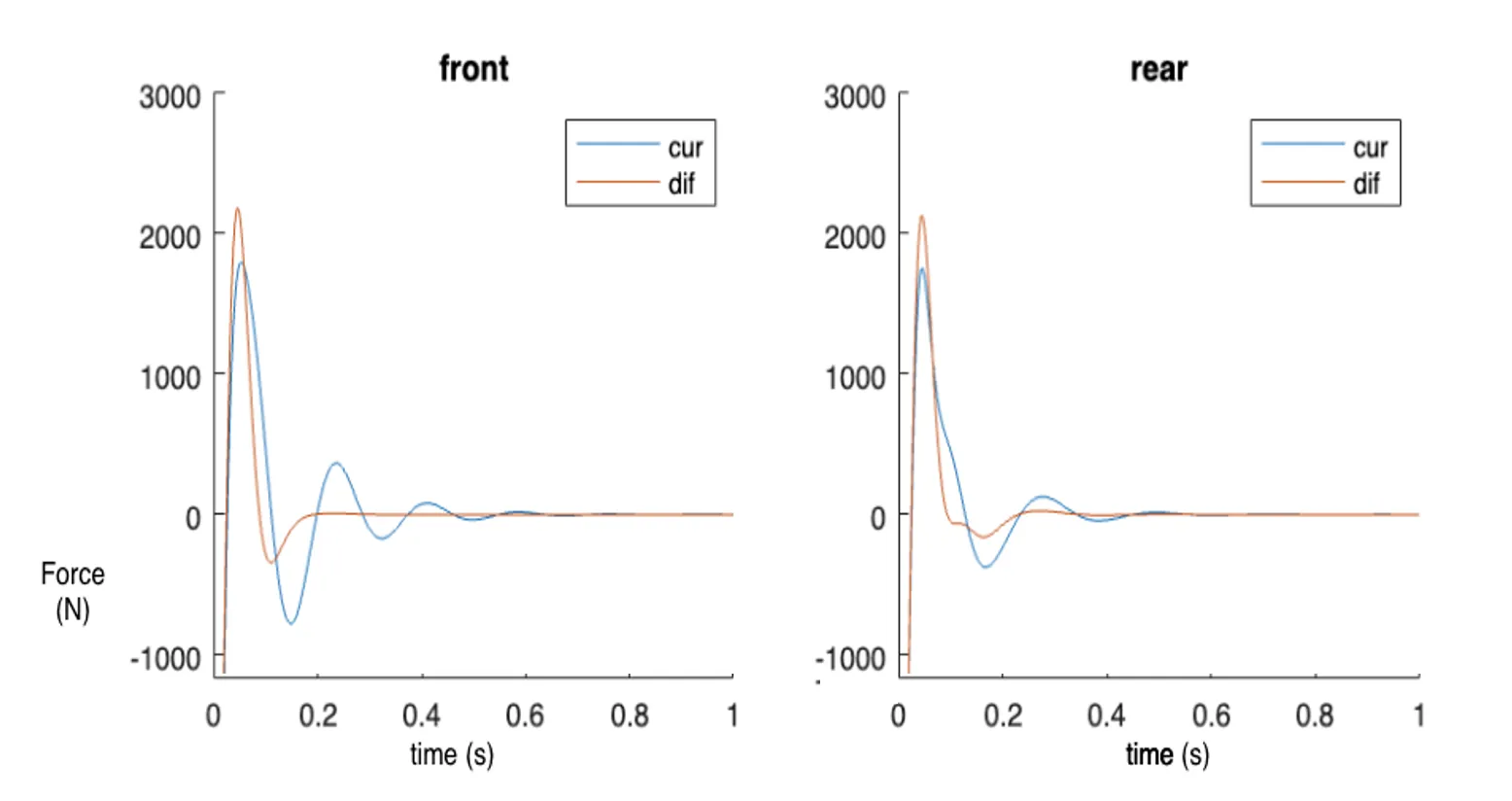
The honest result: the GA wanted to shed about 15 kg of total mass (207.3 → 192.1 kg) and trim the front unsprung mass slightly (×0.96), leaving the rear nearly untouched. That bought a faster settling time and noticeably less sustained tire-load oscillation at the cost of a marginally higher initial overshoot — a tire that finds steady grip again sooner after every bump. It confirmed the intuition that unsprung mass matters, but it also told us where the payoff was (front more than rear) and how much total mass reduction was worth chasing before the returns flatten out. The next step, which I documented for future work, is complex and realistic road profiles and validating against real damper data from the car.
Choosing tires, and defending it in the Design Finals
For competition I was chosen to present the tire selection for the suspension group — running the simulations behind which tire compound and construction the car would race on, and then presenting and defending that decision as part of the suspension design package.
The specifics of that analysis are team knowledge, so I’ll keep it general: the work was about matching tire behavior to our car’s mass, load transfer, and the demands of the autocross and endurance events, and being able to justify the trade-offs quantitatively rather than by feel.
What I can talk about is what it’s like to defend that work in a Design Final. The qualifying design judging is almost like a presentation; the final is something else entirely. You make the top 10, and then the judges come to you — and they don’t ask surface questions. They want to know why this number, why not that one, what happens if an assumption is wrong, how you validated it. Standing in front of that and being able to answer for your decisions, in detail, under pressure, is one of the things I’m most proud of from the whole two years. We finished 6th in the Design Final the first year and made it back again the next.
The data that almost nobody looked at
Here’s the thing I noticed across all of SCR25’s test days: the most valuable thing the car produced was its data logs, and almost no one could get to them.
Every run, the car’s MoTeC ECU writes a log file packed with everything — oil, coolant, and fuel temperatures and pressures, engine-health channels, the suspension travel at each corner (exactly what you need to tune dampers), GPS, speed, and throttle/brake position for driver coaching. But only one laptop on the team could physically connect to the ECU and pull the log. And on track we have no internet — not even mobile data. So the one log that mattered got passed around on a USB stick, slowly, one person at a time. People who needed the data simply didn’t get it, and the analysis that should have happened between runs mostly didn’t.
That observation turned into the second half of my time on the team, and eventually into joining the Data Acquisition subteam. Three problems, solved in order: get the data to everyone, give everyone the same tools to read it, and capture the one thing the logs were missing.
A NAS you can carry to the track
The first problem — sharing — I solved with a server we could bring with us.
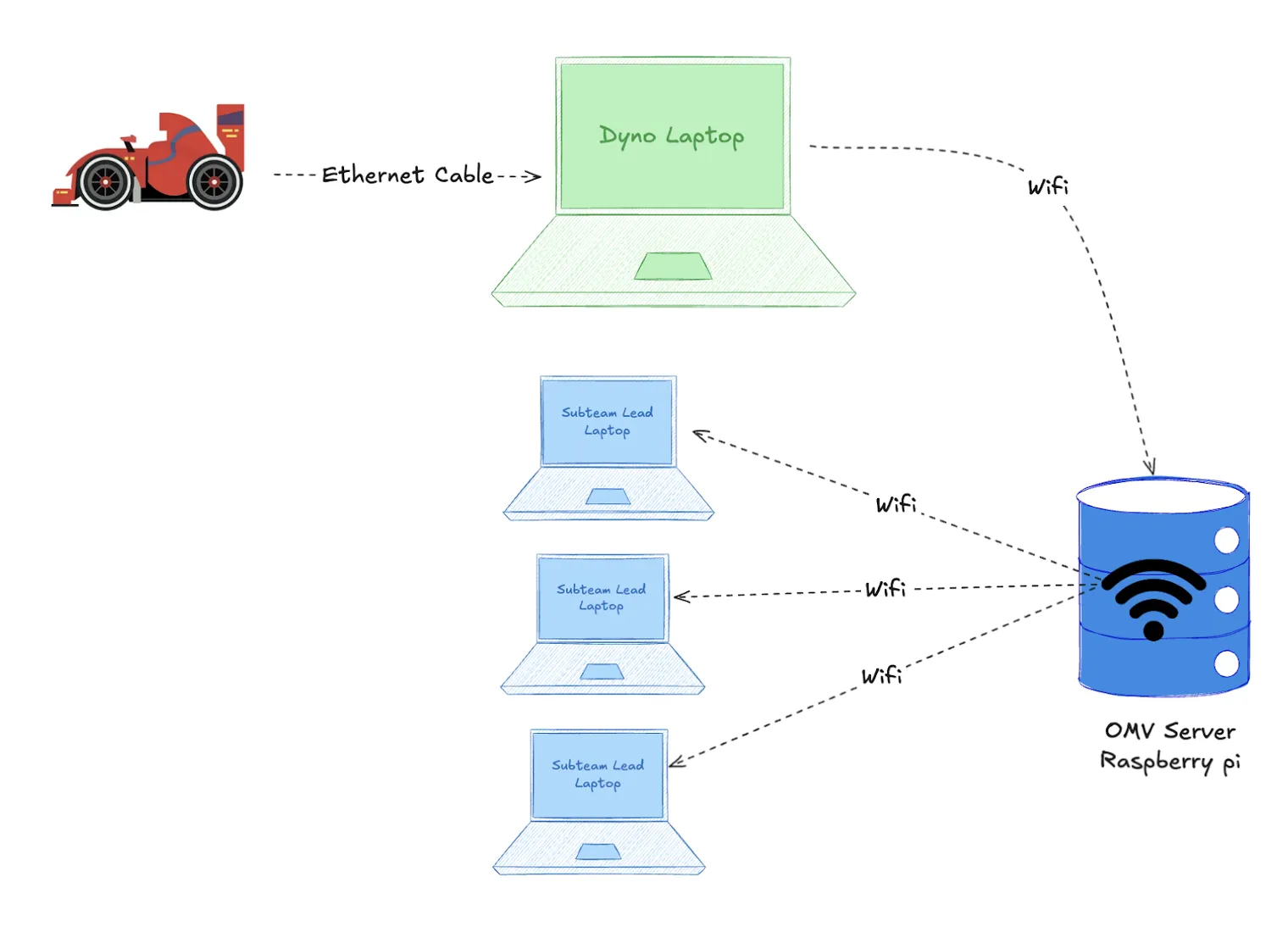
The idea: a box that hosts its own local WiFi, so on a track with zero connectivity everyone can still join one network, mount a shared folder as a normal network drive (SMB, so it works the same on Windows, Mac, and Linux), and read or write logs at full speed instead of sneaker-netting a USB stick around the paddock.
Version 1 was deliberately minimal: a single Raspberry Pi broadcasting WiFi off its own antenna, with a USB drive as the shared storage. I documented the whole build — the trick is to install OpenMediaVault first and only then layer the access point on top with hostapd (the AP), dnsmasq (a small DHCP/DNS server handing out leases on the WiFi subnet), and iptables for NAT — otherwise the network config and the NAS software fight each other. It worked, and the chief engineer immediately wanted it as real team infrastructure.
So version 2 got serious. When I joined DAQ, the brief was: make it faster, bigger, and more reliable. We repurposed a second-hand PC the team wasn’t using, installed OpenMediaVault on it, and paired it with a dedicated WiFi router on a static IP. My favorite detail: we powered the router straight off the PC’s power supply, so the entire system is one switch — flip the PC on, the router comes up with it, the SSID starts broadcasting, and anyone in the paddock can connect and start moving files. No laptops, no cables, no waiting.
One workspace to rule them all
With the data finally flowing, the next bottleneck was the tool everyone used to read it: MoTeC i2.
i2 is powerful, but every person on the team had configured it differently — different channels, different math, different layouts. So two engineers couldn’t even reliably look at the same thing; half of any data session was spent arguing about whether two plots were showing identical data or not. And plenty of people just didn’t open i2 at all, because setting it up from scratch wasn’t worth the time.
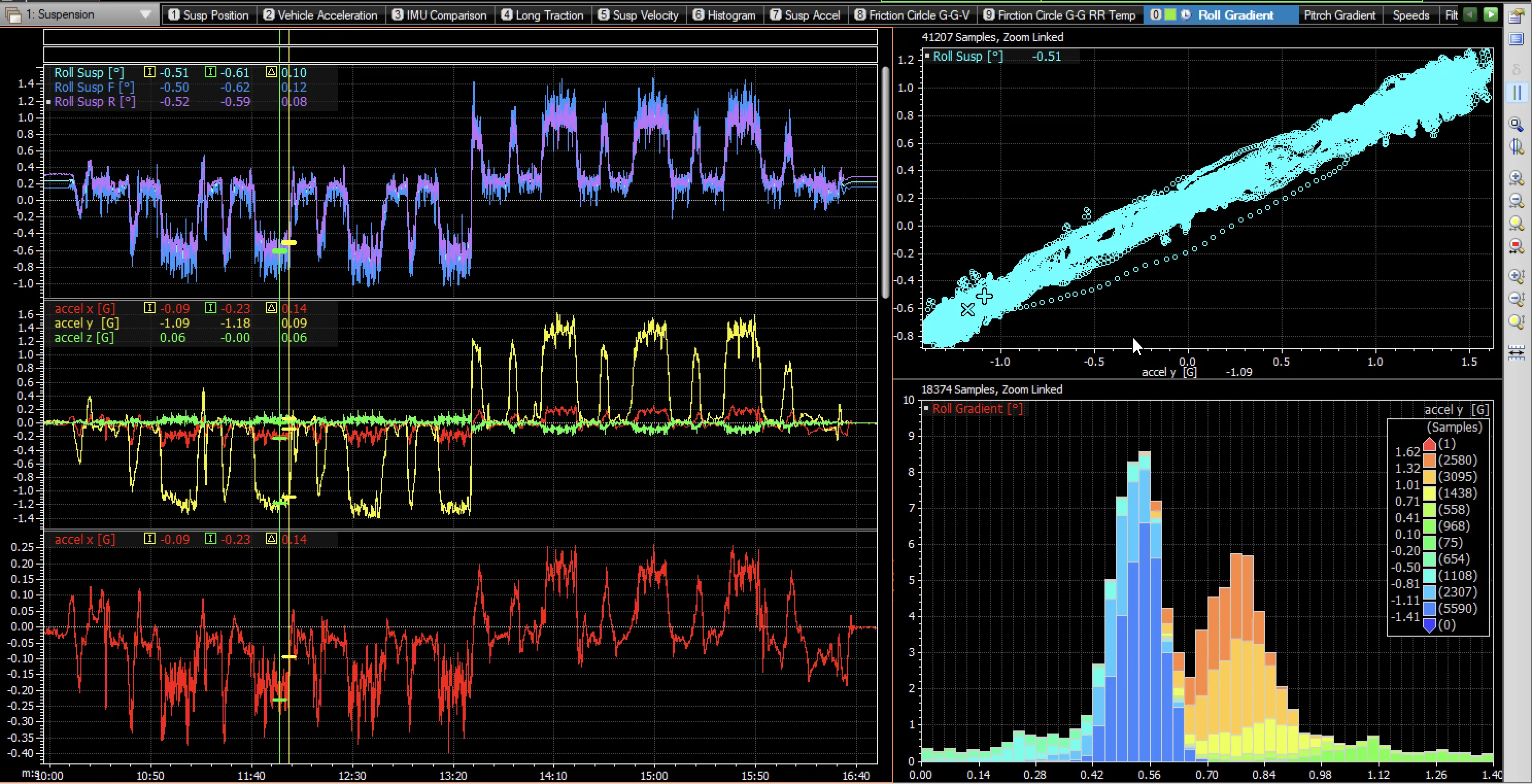
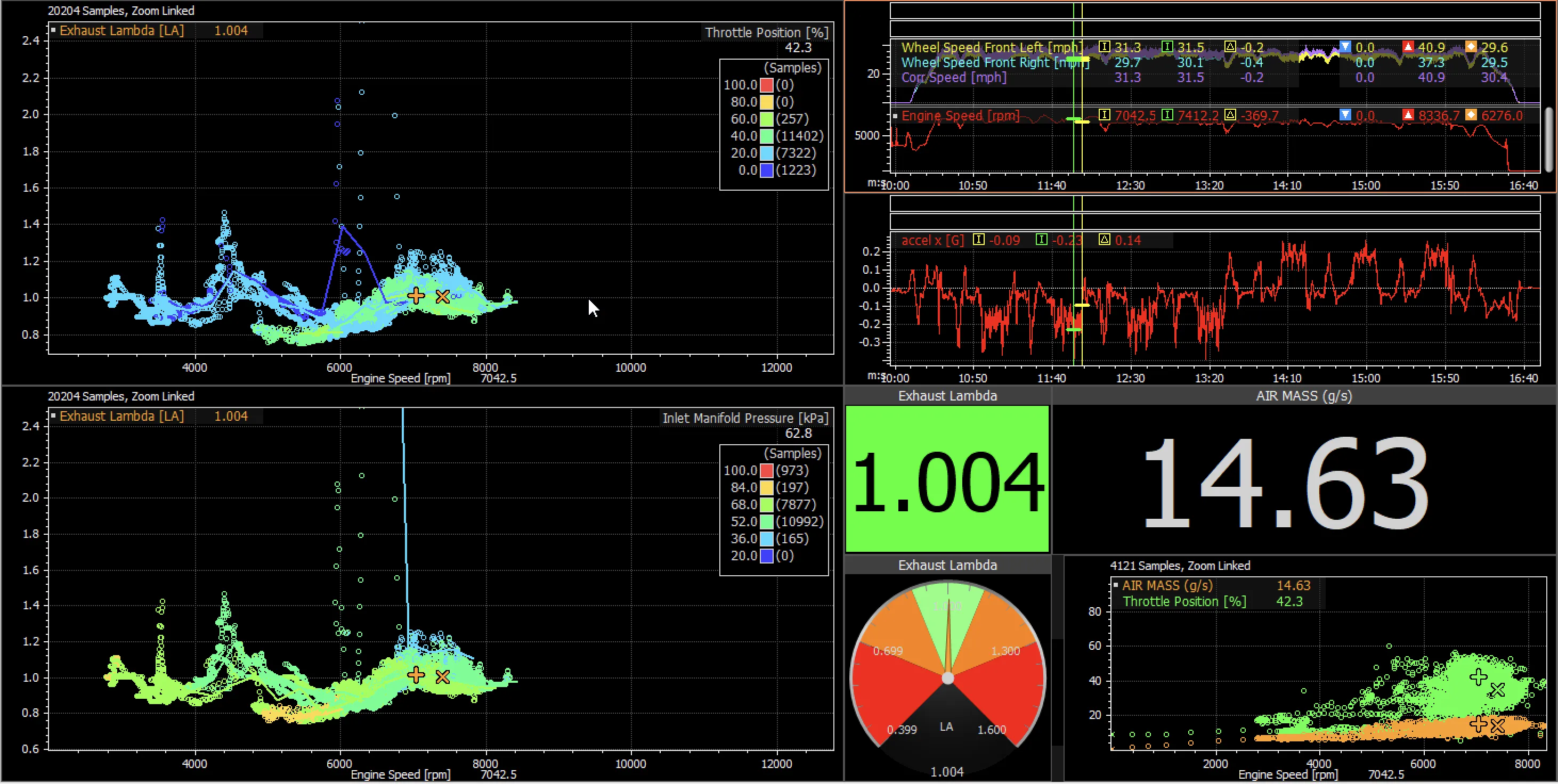
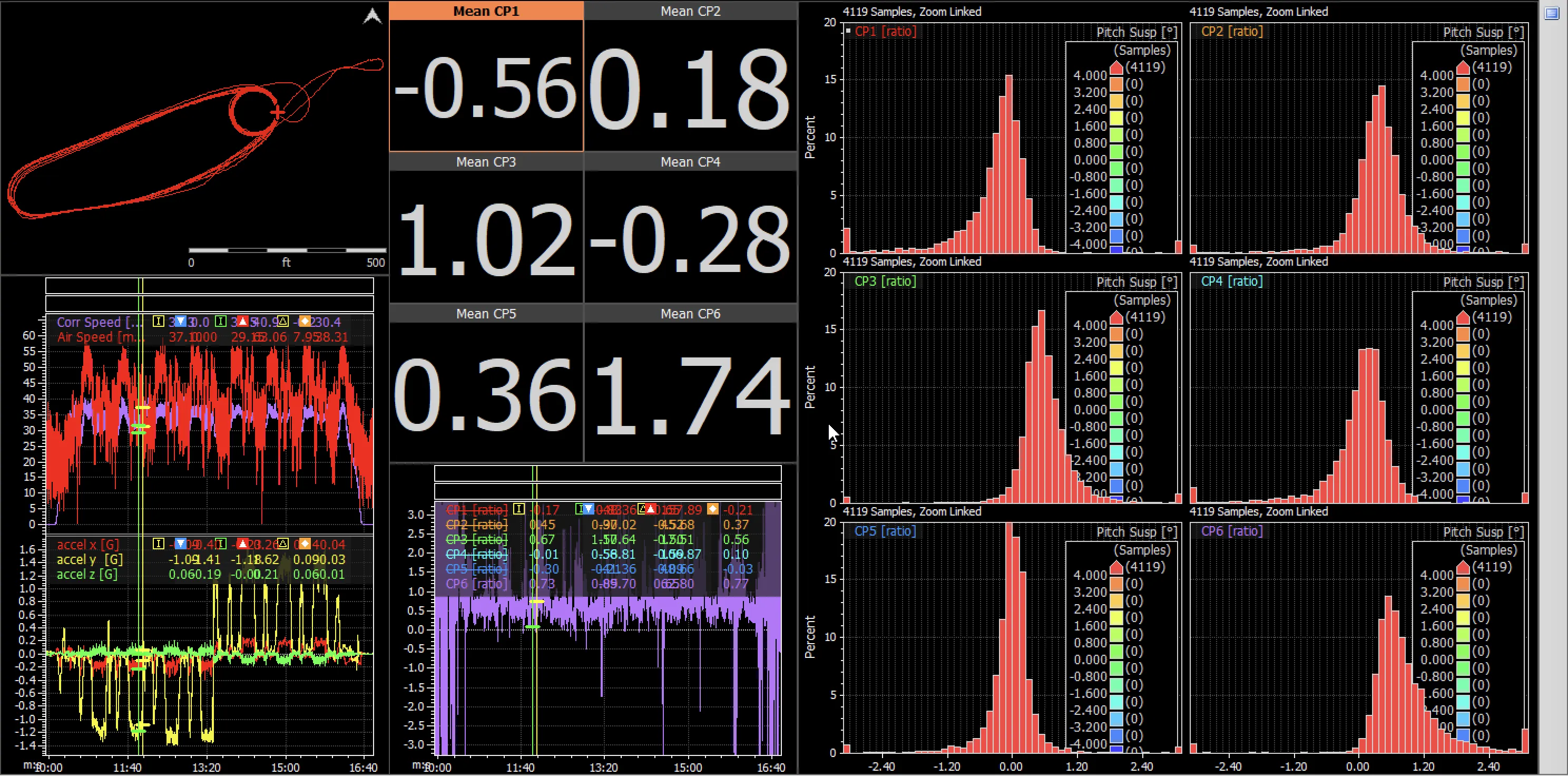
I built a single shared i2 workspace that consolidates the genuinely useful stuff — the important plots, math channels, warnings, and alarms — into one ready-to-go foundation, organized per subteam. The point wasn’t to force everyone into one view; people are free to add and modify whatever they want. The point was to make the default good enough that getting into data analysis takes seconds instead of an afternoon, so people actually do it and go hunting for performance in their own corner of the car.
The missing piece: welding the setup sheet into the logs
This is the project I’m most proud of in the DAQ subteam.
Every run we now had a log, shareable and readable. But the logs were missing the single most important piece of context for actually learning anything: what the car was set to. The damper settings (each corner’s damper has four adjusters — low- and high-speed compression and rebound), the fuel load, tire ages and serial numbers, spark-plug condition, ride heights, pressures — none of it was recorded. After a test day, the documentation of the car’s state ranged from sparse to nonexistent.
Without that, optimization is impossible. You cannot learn how a subsystem responds to a change if you don’t know what the change was. And you lose the institutional memory: next year’s team should be able to look back and see exactly how the car was configured, when it changed, and why.
So I went deep into the MoTeC file format. The ECU writes the binary log as a .ld file — but I discovered it also produces a companion .ldx file, which is plain XML, and that i2 reads the .ldx and surfaces whatever values it finds inside the log view. There’s no documentation for any of this. So I spent about a week reverse-engineering the .ldx schema — figuring out which XML fields map to which displayed values in i2 — until I could write data into a log that would simply show up when anyone opened it.
Around that, I built a web application:
- Per-subteam setup forms. An admin creates users and assigns them to subteams; when you log in you see only your subteam’s form. The forms are defined in YAML, one per subteam (suspension, powertrain, aero, drivetrain, chassis, electronics, ergo, driver, DAQ, chief), with typed fields, units, and tabs — the suspension form alone covers dampers, corner alignment, parameters, temperatures, and tires.
- Smart defaults. Each field shows the most recently logged value, so you’re editing a delta from the last run, not refilling a blank sheet. Every change is audited and visible in an admin dashboard.
- The automatic injection. This is the part that made it click. The backend watches the NAS for a new log to appear (the electronics team uploads it right after a run). When one shows up, the server pulls the latest value of every form field, injects them into the
.ldx— text fields as XML detail strings, numeric fields as MoTeC math constants with units — and saves it back. A verification loop re-checks the files and re-injects if i2 ever rewrites them.
The injection pipeline. Engineers submit setup values through the web app; when electronics uploads a new log to the NAS, a watcher injects the latest setup into the log's companion .ldx file — so the car's exact configuration travels with the data permanently and appears automatically in MoTeC i2.
The outcome is the thing I find genuinely satisfying: the setup sheet is now part of the log file, forever. Open any run in i2 and the car’s exact configuration is right there next to the data. No more orphaned spreadsheets, no more “what were the dampers on this run?” And next year’s team inherits a complete, searchable history of how the car evolved.
The whole thing is built as a small stack — FastAPI + SQLite on the backend, a Next.js/React frontend — dockerized, and deployed onto the same NAS. So it runs on the box we already carry to the track. No cloud, no internet required. This is the system the judges compared to F1.
What’s next
I have a few more projects in the pipeline — among them tooling to derive extra channels from track-side audio and a video-telemetry overlay renderer for driver coaching — that I’ll add here as they come together.
For now: best competition in team history, a first-ever podium, and a data system that finally does justice to what the car has been telling us all along.
Fight on. ✌️